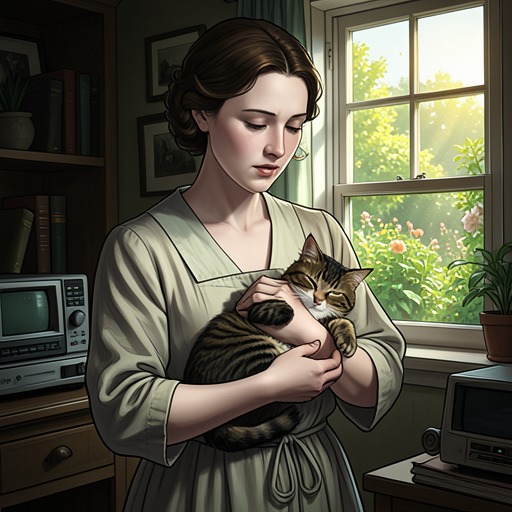
The ethics and guilt of animal euthanasia
The FriendThe ethics and guilt of animal euthanasia are explored through Narrator’s decision to have an elderly cat put to sleep, a choice intended to end suffering that instead becomes an enduring source of doubt. The episode places practical veterinary judgment beside the limits of understanding an animal’s wishes: even an act meant as mercy can leave the person responsible unsure whether care and harm have become inseparable.
Illness and the Decision
The dilemma begins with the familiar sequence of trying to help a sick cat: a veterinary visit, diagnosis, surgery, medication, and a period of hope followed by renewed uncertainty. Treatment does not settle the central questions. Narrator wonders how much pain the cat is experiencing, whether continued care serves the animal or the person who cannot let go, and whether death might be preferable to ongoing distress. The decision is therefore not presented as a simple refusal of treatment. It follows efforts to intervene and an unresolved attempt to weigh suffering against the risks of further medical care.
An ultrasound reveals a mass in the nineteen-year-old cat. The veterinarian explains that surgery is possible but urges consideration of the cat’s age and condition; at nineteen, she may not survive an operation. The alternative is euthanasia. Narrator must make this choice while confronting two facts that pull in different directions: the cat is already suffering, and any intervention carries uncertainty. The scene gives no formula for resolving that conflict. Age, pain, possible survival, and the prospect of further treatment become factors in a judgment that still has to be made without access to the animal’s own account.
Language, Agency, and the Procedure
The episode also examines how language shapes responsibility. J. R. Ackerley objected to euphemisms for killing animals, but Narrator finds his blunt vocabulary troubling when applied to a sentient being. The ordinary alternatives feel inadequate: softened language can obscure what is being done, while direct language can make a necessary act sound like deliberate destruction. The difficulty is not merely verbal. Naming the act exposes the moral weight of the decision, yet no term can establish whether the decision was right.
Before the procedure, the veterinarian asks whether Narrator wants to remain with the cat, and Narrator agrees. The veterinarian explains that there will be two injections, beginning with one intended to calm the animal. The first injection proves problematic because dehydration has affected the veins. Until then the cat has remained still; now she becomes alert, reaches out to touch Narrator’s wrist, and lifts her head to look at her. These small gestures acquire great force because they occur at the very moment when Narrator is already required to interpret what the cat can and cannot communicate.
Narrator carefully distinguishes the cat’s observable actions from the meaning she gives them. She does not claim that the cat literally spoke. Instead, she hears the gesture as a plea that seems to separate wanting relief from wanting death. This imagined translation cannot serve as proof of the cat’s wishes, but neither can Narrator dismiss it once the moment has occurred. The episode holds both possibilities in view: the cat’s distress may have been a response to the difficult injection, while Narrator experiences it as a warning that the decision has gone wrong.
The veterinarian becomes flustered and takes the cat out of the room before Narrator can respond. In a large, busy hospital with multiple wards, Narrator does not know where she has gone. Ten minutes later, the veterinarian returns and places the cat, now dead, on the table. The abrupt absence and return leave a gap in Narrator’s experience of the procedure. The narrative does not explain what happened during those ten minutes or resolve the medical circumstances; it stays with the consequence that Narrator encounters and the question that escapes her before she can stop it: what has been done.
Guilt and the Afterlife of the Choice
The decision does not end when the procedure does. Narrator later connects the intensity of her guilt to the fact that this cat had been her least favorite. The cat was aloof and resisted being cuddled or held on a lap, yet she would climb onto Narrator’s hip while Narrator slept. That private, indirect form of closeness complicates any simple account of their bond. A relationship that had seemed emotionally distant becomes, after the cat’s death, the focus of persistent thought.
Small reminders bring the final illness back: finding a hair or whisker in the apartment recalls the cat’s strained, urgent mewing during her last days. Narrator’s memory links the ordinary residue of a shared home with the animal’s earlier distress, making bereavement recur through objects and sounds rather than through any settled explanation. The guilt is not resolved by deciding that the cat had been loved enough, nor does the text establish that Narrator could have known what the animal wanted. Instead, it shows how uncertainty survives the act of choosing.
The experience also changes Narrator’s willingness to keep another cat. She does not want to witness another animal suffer and die, and she fears what would happen to a future pet if she died first. These concerns extend the ethical problem beyond a single veterinary decision: taking responsibility for an animal means confronting not only its present needs but also the possibility that its future care will depend on a person who may not always be there. The episode presents euthanasia as one concentrated moment within a longer obligation of care, rather than as an isolated choice.
Narrative Significance
The episode’s moral force comes from the distance between intention and knowledge. Narrator has reasons to consider euthanasia: the cat is old, has a mass, is suffering, and may not survive surgery. Yet the cat’s gesture during the procedure becomes an accusation in Narrator’s hearing, and the unexplained interval before the veterinarian returns prevents that experience from being neatly closed. The text neither declares the choice merciful nor recasts it as definitively wrongful. It shows how a decision made under constrained knowledge can remain emotionally unsettled even after its outcome is irreversible.
This account also makes animal agency present without pretending it can be fully translated. The cat is not only the object of a medical decision: her touch, look, and altered behavior interrupt the human plan and acquire significance within Narrator’s recollection. At the same time, the narrative marks the boundary between what the cat does and what Narrator believes she is expressing. That boundary is central to the ethics of care here. Responsibility requires acting for an animal whose suffering may be visible but whose preferences cannot be confirmed in human language; afterward, the caregiver must live with both the necessity of having chosen and the possibility of having misunderstood.